
Strength Training and Pilates: Why They're More Connected Than You Think
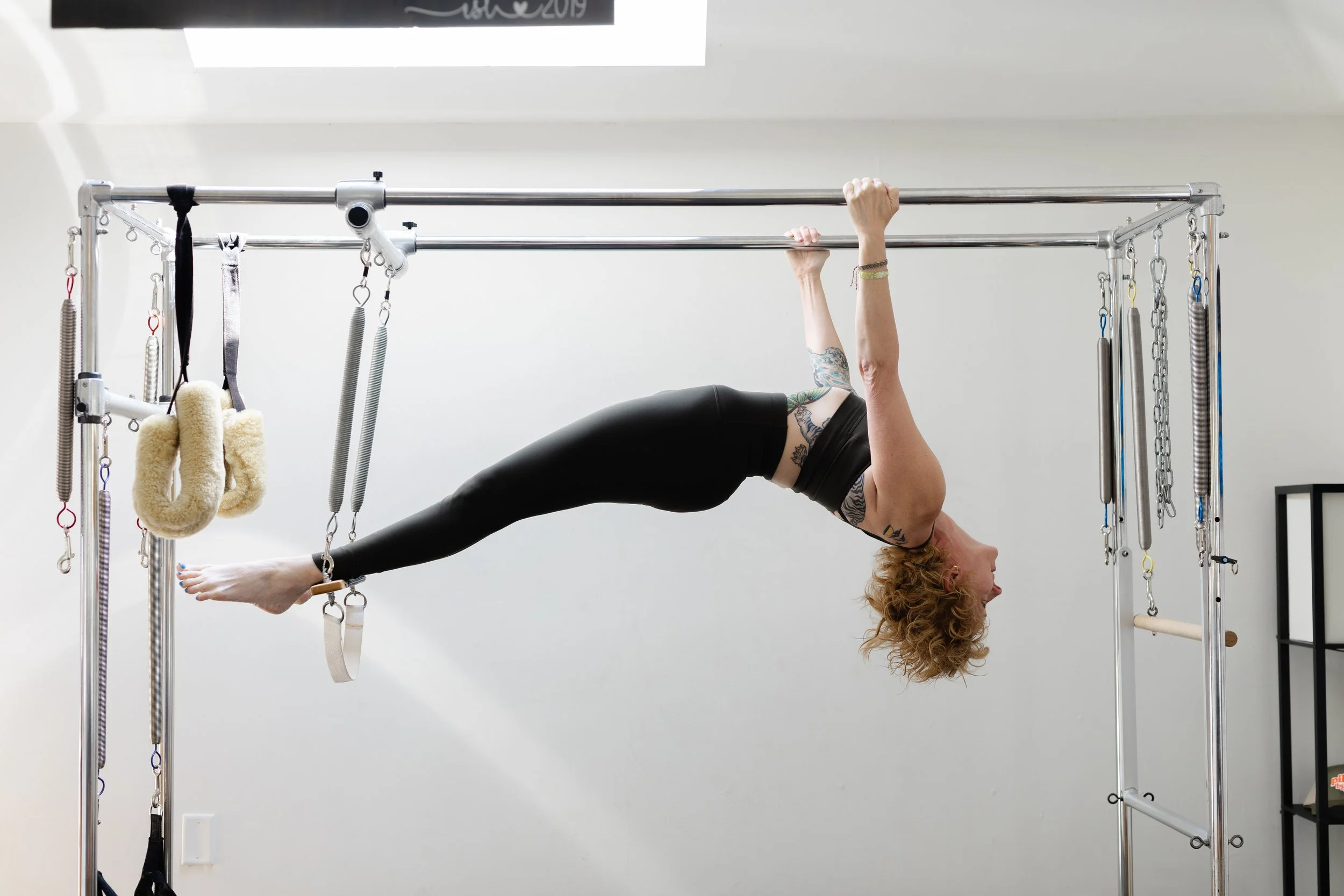
If you've spent any time in the fitness world, you've probably heard people talk about Pilates and strength training like they're two completely different worlds. One is "low impact" and "core work." The other is "heavy lifting" and "building muscle." Pick a lane, right?
I'd push back on that. After 20+ years of teaching, I've come to believe these two practices aren't opposites at all — they're two expressions of the same underlying skill: the ability to listen to your body while you move.
Strength Without Awareness Is Just Effort
Here's something I see often, in the gym and in the studio: someone moving through an exercise with a lot of effort, but very little awareness. They're pushing, gripping, bracing — but they're not really there. The mind has checked out while the body grinds through reps.
That's where injuries happen. That's where progress stalls. And honestly, that's where a lot of the benefit of strength training gets left on the table.
Real strength — the kind that holds up over decades, not just one workout — requires the same thing Pilates has always asked for: presence. Knowing where your ribs are. Feeling whether your breath is supporting the movement or fighting it. Noticing which side is working harder, and why.
The Question That Changes Everything
In a traditional approach to movement — whether it's a squat, a deadlift, or a Pilates Hundred — the question is usually: "Am I doing this correctly?"
That's not a bad question. Form matters. But it's an outside-in question. It's about matching a shape, hitting a position, checking a box.
There's another question that changes the entire experience of movement: "What am I noticing while I move?"
This is an inside-out question. It's not about whether your form looks right from the outside — it's about what's actually happening inside your body as you move. Where is the effort coming from? Is your breath free or held? Are you bracing out of necessity, or out of habit?
When you start asking that second question — in the gym, on the reformer, anywhere — everything changes. Movement stops being something you perform and starts being something you experience.
Why This Matters for Strength Training Specifically
Strength training has a reputation for being purely mechanical — sets, reps, progressive overload, numbers going up. And those things matter. But the people who train for the long haul, who build strength that actually serves their lives, are almost always the ones who've learned to bring awareness into the heavy lifting. Not instead of intensity — alongside it.
This is where Pilates principles — breath, control, full-body connection — aren't separate from strength work. They're what make strength work sustainable.
Two Practices, One Foundation
I think a lot about what it means to build a body that feels strong and feels good to live in. Not one or the other. Both.
That's the thread running through everything we do here — whether it's a Pilates session, a strength-focused class, or simply learning to notice what's happening in your body on any given day. Strength and awareness aren't competing priorities. They're the same skill, practiced in different contexts.
Why Both Matter — Especially for Women
This isn't just a philosophy — there's real research behind it, and it matters more for women than most of us realize.
Strength training protects your bones, especially through midlife and beyond. Every year after menopause, bone density drops 1–2% without intervention, and falls affect 1 in 4 adults over 65 each year. The encouraging news is that bones respond to stress — lifting weights signals bones to become denser and stronger, and regular resistance training can slow bone loss and help prevent osteoporosis. Research has even shown that just 30 minutes of resistance and impact training twice a week improved bone density, structure, and strength in postmenopausal women with low bone mass, without adverse effects.
Pilates builds the deep stability that supports everything else. A 2025 study found that Pilates-based core training improved deep stabilizer muscle thickness and contraction timing, particularly in the transverse abdominis and internal obliques — the muscles that quite literally hold you together during heavier lifts. Research on older women also shows Pilates-based programs enhance strength, balance, flexibility, and cardiovascular endurance.
Together, they cover what neither does alone. Pilates activates and stabilizes, while strength training builds and strengthens — combined intelligently, they create bodies that move efficiently, perform powerfully, and hold up over time. One without the other leaves a gap. Strength without stability is fragile. Stability without strength doesn't protect your bones.
For women specifically — navigating hormonal shifts, bone density changes, and the everyday demands of caring for everyone but themselves — this combination isn't a luxury. It's foundational.
More to come on this — I have a feeling this conversation is just getting started.
Curious about how this philosophy shows up in our classes and trainings? Explore our class offerings or learn about SOMApilates™.
